The Scandalous Misunderstanding Incident of T-ara’s Bullying Case

T-ara was a 6-member girl group under MBK Entertainment who made an official debut in 2009. The original line-up consists of:

Boram

Qri

Soyeon

Eunjung

Hyomin

Jiyeon

Hyomin – Soyeon – Jiyeon – Qri – Boram – Eunjung

During their period, there were 2 members added: Hwayoung and Areum but they either left or was kicked out by the CEO, resulting in the original-form T-ara again.

Back in 2012, T-ara, along with Girls’ Generation, was one of the most popular girl groups in Korea. However, a bullying controversy within the group targetting one of their new members Hwayoung booming in 2012 destroyed their image and popularity. T-ara lost most of their fans and became the most-hated group in Korea. Only until recently, 6 years after their scandal, did the CEO of the MBK Entertainment confirm their innocence.

So what was the scandal about?

Hwayoung

On July 23th 2012, T-ara performed their hit song “Day By Day” on a music show when Hwayoung did not perform after claiming having a hurtful sprain in the waiting room. Only until this May did the CEO exposed that Hwayoung demanded casting in plaster even though the X-Ray doctor claimed no serious problem with her leg.

On the next day, T-ara held a big concert in Japan packed with 14 thousands fans. With her leg hurted, Hwayoung left the rehearsal for the concert which forces other members to quickly change their choreography from 8 to 7 members. Hwayoung only returned to perform one song on a chair. Later in 2015, one of T-ara staff revealed to the netizen that instead of resting in a hotel during the rehearsal/concert, Hwayoung decided to go to a nail salon.

And, the mess started with members’ argument on the Twitter:

After the concert, T-ara members were upset with Hwayoung. Other members started tweeting about commitment and determination.

Hyomin: “The differences in levels of determination^^, Let us all have more determination. Fighting!!!”

Jiyeon: “The differences in levels of determination ^^, Always be humble ^^ and sensible ^^ I applaud you, acting genius ^^”

Hwayoung: “Sometimes, even determination alone is not enough. At times like these, I feel upset but I trust that it’s a blessing in disguise from the heavens. God, you know everything right?”

Later, Hwayoung and her twin sister Hyoyoung also worsen the situation by tweeting:

Hwayoung: “Sometimes, even determination alone is not enough. At times like these, I feel upset but I trust that it’s a blessing in disguise from the heavens. God, you know everything right?”

Hyoyoung: “My other half is going through troubles… It hurts my heart …. No matter what people say you can get through this Ryu.”

Hwayoung: “…..I only have you ….”

Hyoyoung: “Having a pretty face doesn’t matter if your heart is evil. Is the person who is hurting not considered a human? I’m hurt too. I honestly want to cry. Let’s just continue to train hard….”

The Korean netizen considered this as cyber-bullying because there were 5 people against 2. Bullying means repeatedly and intentionally torturing another person. In this case, it was reasonable to conclude that they had a fight within the group about one’s bad behavior but not bullying. They could have made up and moved on but netizens blew the story up and there was no returning from that.

To address the control of Korean netizen over the fate of a group like T-ara, I will discuss about how netizen rapidly spread the false rumor with evil edits and their bullying attitude towards T-ara.

The Korean netizen started gathering countless of evidences that proved Hwayoung was a victim of bullying.

  1. Boram breaks Hwayoung’s umbrella
During an idol olympics show, Boram went to Hwayoung in the rain, punched her umbrella and destroyed it.

In reality, the full fancam showed that Boram just put her umbrella over Hwayoung’s as Hwayoung is taller, which accidentally broke the umbrella.
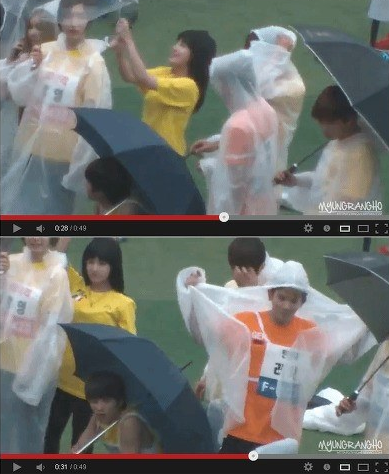
For me it seemed like an accident, but with specifically the capture angle at first, Korean netizen irrationally claimed that was a bullying case.

2. Eunjung shoves a rice cake in Hwayoung’s mouth

It is considered as dangerous to put a whole sticky rice cake in the mouth. There are many cases in Korean which people chocked up and died because of the sticky structure of the rice cake.

However, when Eunjung was feeding Hwayoung with the rice cake, you an see the MC at the back was laughing along with the girls, which means the show’s atmosphere was not bullying at all. Japanese netizen who are more familiar with the context their own variety shows agreed that the girls didn’t look like they were bullying her at all.

There are also other when Hyomin forced Jiyeon to have a big sticky rice cake into the mouth but nobody started rumors of Jiyeon being bullied.

The Korean netizen did not even bother to see how T-ara members interact with each other for the whole show. They were joking around and having fun which was absolutely normal. Because of the rumor, Korean netizens suddenly became sensitive with any actions of the members targeting at Hwayoung and got serious even with funny jokes.

3. Hyomin poked her finger at Hwayoung’s face

When all members lined up to make a group greeting and pointed at the camera to signal the start, Hyomin oddly stroke her finger upwards, and accidentally poked her finger at Hwayoung’s face.

This evidence clearly shows the absurdity of Korean netizens in trying to slander T-ara’s image. After accidentally hitting Hwayoung, Hyomin immediately looked at Hwayoung to check and leaned towards Hwayoung as a mean of apology. How can people view such accident as bully? A person “cleverly” capped the video at certain parts to trick people to believe in the bullying case.

Rumors are just rumors. Once the truth is revealed, all wrong rumors become false assumptions. T-ara could clearly defend themselves, get the rights back, and prove their innocence. Unfortunately, there is something that hasn’t changed: the netizens’ attitude.

At the beginning, several rumors posted on the internet spread like a wildfire. One netizen claimed that he was a back-up dancer for T-ara and observed Soyeon shouted at Hwayoung and Jiyeon slapped her face during a rehearsal for making a tiny mistake. The netizen got later caught by the police for lying and spreading false information.

A woman named Hong Ga Hye claimed to be Hwayoung’s cousin and confirmed that Hwayoung was bullied by other T-ara members. Later, she was also caught for lying.

These are two of the most famous rumors that everyone at that time believed in. Over 130,000 netizens signed a petition for a T-ara disbandment, at the moment when all information was through fake stories and video captures.

Without knowing what was really happening, Korean netizens gave themselves the right to defame and despise these idols. Once they believe something is right, they close their eyes and ears, only hear what supports their belief. Netizens think they’re gods, and it doesn’t matter if the truth is ever revealed because they won’t care.

From around 2014 till now, tons of clarification post are updated by T-ara staffs and fans but in the end Korean netizens keep refuting their hard work and effort: “So what? They are flop anyways. There is nothing that can save their reputation and image now.” Whenever they cried and tried to tell their story, netizens refused to listen to them. And when they tried to move on, to continue promoting, netizens would berate them for coming back out.

Turned out, bullying was not committed by T-ara but by the netizens of Korea who enjoy bringing others’ reputation and career down and refuse to believe anything that doesn’t fall in line with what they want to believe.

Standard

Just K-Pop Thing!

Recently, the term “Hallyu” (“한료” in Korean) has been using more and more frequently. The term can be understood as Korean Wave, referring to the expanding globalization of K-Pop.

K-Pop as we know for today started of with a three-member group “Seo Taiji and Boys” (“서태지 와 아이들” in Korean) in the 90s. Their clever use of contemporary popular Western music genres (dance music featuring rap) was a big hit in South Korea when ballads and trot songs were mainstream, which changed a whole South Korean music industry. Acknowledging the popular of this new concept, several entertainment companies adopted this style in creating their own groups. Then later in 2000, a Korean boy group called H.O.T first marked the spread of Kpop with their large-scale popularity after successfully holding a concert in a gymnasium in Beijing. For the first time, the word “Hallyu” was used for Chinese fans’ enthusiasm for Kpop. Soon later, the Hallyu Wave rocketly bloomed with the birth of DBSK, Wonder Girls, Super Junior, Girls’ Generation, Big Bang, 2NE1 conquering the heart of fans all over the South East Asia. In the late 2009, for the first time in the South Korean music industry, Wonder Girls’ hit single “Nobody” entered the Billboard Hot 100 chart at number seventy-six.

The wave is now widespread all over the world and shows no signs of cools off anytime soon. In 2012, the phenomenal hit single “Gangnam Style” of PSY went viral, and quickly in the late 2012 it became the first video in Youtube’s history to exceed 1 billion views. After almost two decades since the start of Hallyu, except for PSY, the formula for creating an idol group hasn’t changed and has proved even more successful. EXO, BTS, TWICE, BLACKPINK with catchy melody and eye-catching complex choreography started dominating the world music industry. For BTS, they achieved huge success in America as the first Korean group to win a prize (Top Social Artist Award) at the Billboard Music Awards and to get a Platinum (1,000,000+ units) certification with the single “MIC Drop” in the United States.

Previously, K-Pop groups would mainly hold concerts in South Korea only and occasionally in Asian countries such as Japan or China. Today, they’re being held all over the world. With KCON, an annual Korean Wave convention, taking place not only in the United States, but also expanding to Abu Dhabi, France, Mexico, and Australia. With many groups holding world tours from Asia to America to Europe, KPop has truly become a worldwide phenomenon.

So what exactly is an idol? What do they do in their schedule?

Trainees of a company who are in the final line-up group after successfully passing all the auditions and evaluations in an entertainment company are considered as idols. They are “manufactured” to be the ideal type for fans everywhere. They have to undergo years of training, dieting and competition among other trainees to eventually make the cut. The most common thing you’ll see in an idol’s schedule is music shows recordings. Whenever they release new music, they will promote the song on different music shows such as M!Countdown, Inkigayo, Music Bank or Music Core. They will also appear on public shows such as Running Man, Weekly Idol, Hello Counselor since Koreans enjoy watching variety programmes. It is a great opportunity to receive more recognition from the general public.

It is common to see K-Pop groups rather than soloists. I would argue that they shine brighter together as a whole. They compliment each other and smear the others’ weaknesses. In a group, each member will be in charge of different positions. The expected positions are main vocal (the most stable and has the best techniques), main dancer and main rapper. Different from the Western industry, Korean appreciate the idols’ personalities and charms. A member of the group who is a natural when it comes to variety show (usually the humorous members to be on set) while another member can be the visual of the group (often the most beautiful or handsome member based on Korean standards). Another aspect that helps globalizing K-Pop is their performances. Most songs are accompanied with killer choreography that show off the synchronization of the group. It is mesmerizing watching the performances and also another reason why they want to promote the songs on different broadcasts.

Through these public appearances, these groups have formed a decent fanbase for themselves. The companies will now hold plenty of events to encourage more fan-idol interactions. The most famous experience is called fansign. To get a spot in this event, fans need to buy physical albums to be given a lottery ticket to enter; sometimes it will be a fan-club-event only and you have to be a member on the fancafe website to register. There are stories where fans bought over a hundred albums but none of their tickets got chosen. During the fansign, fan get to meet their idols in a face-to-face distance, chatting and having their albums signed. There will also be a lot of masternims (founder of fansites that takes photos of the members in different events) taking photos from afar. Fans usually give their idols adorable, comedic or scary accessories to pose with. It is always a memorable time for the fans since the intimacy of the event makes them feel closer to the idols. Forget the professional performers on stage, the idols are now just goofy and ordinary people. These moments strengthen the fan’s belief in their bonds with the idols while it also takes away the idols’ rights to have normal lives.

It is still shocking to me seeing how dedicated Kpop fans are in support for their idols. The formation of fansites with masternims and other enthusiastic fans has taken great responsibility for promoting their favorite group by making independent advertisements and boosting their public image by making charitable donations under idols’ names. With so much effort putting in to publicize the good image of their idols, some fans grant themselves the right to interfere idols’ personal life and actions. It becomes an unspoken understanding that in return for the fans’ investment of money and time to support and promote, idols are expected to commit to perform and entertain their fans. Absurd as it may sound, the role as an idol includes understanding that your fans and your group come first over your personal interests and desires.

Therefore, idols’ datings are considered a “betrayal” to their respective fandoms. Fans usually perceive their idols’ datings as a loss of privilege in idols’ lives; idols are no longer exclusive to the fans but have a lover to care and to spend time with. In fear of losing fandom’s trust and huge support, it is common for agencies to place “no dating rules” on their trainees and idols, especially if they are rookies. This rule is to ensure that idols can fully focus on their career and be dedicated to their fans. Idols can try to maintain a positive public image and break their dating news gently but, in the end, it is the fan and the public to decide whether dating is acceptable or not.

Standard